|
A Short Account of the
Founding of the Club
"On April 9th, 1859, a number of "boating
gentlemen" (as they were described) met at the Maid's Head Hotel in Norwich
and formed "The Norfolk & Suffolk Yacht Club". Their reason, it
appears, was that with the growing popularity of yacht racing it had been found
that there were no means of
controlling the behaviour of some of the watermen needed to crew the boats, for
as Nicholas Everitt reported in his book "Broadland Sport": 'So flagrant were the offences of the
more turbulent of this body that matters were brought to a crisis after the
water frolics on Burgh Flats in 1858'. Then, it seems, 'The crews of two racing
yachts boarded one another, lashed their craft together and fought out their
differences to the bitter end'.
Accordingly, the new club was inaugurated in the hope of
exerting some influence on such occasions as well as its avowed
aim of encouraging yacht building and sailing. An entrance fee of two guineas
with an annual subscription of one guinea were fixed but circular letters sent out announcing
these met with a cold reception and at a Committee meeting on April 16th it was
decided that the entrance fee should be halved and by August the
club had secured 52 full members and 42 "honorary" members who,
owning no yachts, were admitted without an entrance charge.
Colonel George
Wilson, of Beccles, owner of the yacht Atalanta, became the first Commodore with
Mr E.S.Trafford as Vice-Commodore and Mr F. Brown Rear-Commodore. A sailing
committee was formed of representatives of the rivers Bure, Yare and Waveney,
plus three Great Yarmouth men -- Messrs. Samuel Nightingale, T. M. Read and W.
M. Bond,. Lowestoft, curiously enough, being conspicuously absent from the whole affair.
At first, the club had no real home of its own and its first
season's programme consisted of one-day regattas at Cantley, Wroxham and Oulton
Broad, where two races were sailed at each. Rowing races were also arranged.
At each regatta, the first race was for what were described
as "cutters" but actually they were sloop-rigged craft with enormous jibs, their
bowsprits being frequently as long, if not longer, than the yacht on the
waterline. Then came a race for lateeners rigged with a lateen foresail and boom
and gaff mizzen. The foremast of these was stepped right in the eyes of the boat
(some were actually stepped on the forward end of the bowsprit) and on this was
hoisted a great spar, sometimes 75ft long, which held the ancient-style sail.
The other mast was stepped amidships and carried a mizzen
which was later to become the mainsail of the true cutter as a jib replaced the
old lateen sail.
Cruises in company were a feature of the early days, the
members taking part often finishing the day aboard the Commodore's yacht for a
social evening.
As the members developed a greater taste for sea racing, they
decided in June, 1884, at a meeting aboard Mr Read's yacht Zephyr at
Cantley, to obtain a clubhouse at Lowestoft and a company was formed to provide a
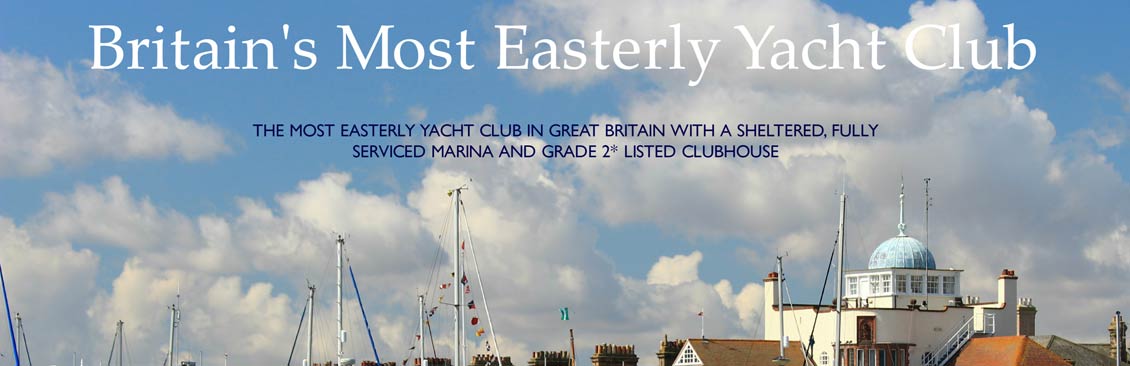
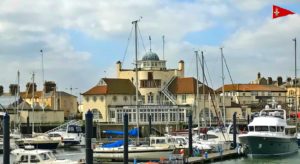
building on the site of the present clubhouse overlooking the Inner Harbour
which was leased from the old Great Eastern Railway Company. The one-storeyed
building arose in 1885 and, after

The original clubhouse on a 1902 postcard
the addition of several rooms, was replaced in
1903 by today's much more imposing structure, the old one being sold to
Lowestoft Town Football Club on whose ground it remains as a pavilion.
The new clubhouse was one of 65 designs received in answer to
an advertisement and from these was selected that of Messrs. G and F. Skipper,
of Norwich, who produced what remains one of Lowestoft's best architectural
features. This entailed a somewhat heavier outlay than had been contemplated but
the Great Eastern Railway handsomely offered to provide the £4,500 needed and
granted the club a long lease on very favourable terms. Later, the generous
railway company was replaced by British Transport Commission from which the club
bought the premises in 1959.

The "new" clubhouse on a 1908 postcard
It was a great day for the club when their new premises were
opened on July 11th, 1903, by Lord Claud Hamilton, then chairman of the Great
Eastern Railway, who was elected an honorary member. The Commodore at that time
was the late Mr Russell Colman, who held that high office on no fewer than 13
occasions, following worthily in the footsteps of his father, Mr J. J. Colman,
who was Commodore in 1878.
After the opening ceremony, a loving cup, presented by Mr A.
F. Mayhew, was handed round and Mrs Colman broke the club flag over the new
headquarters for the first time. Luncheon was then served at the nearby Royal
Hotel and several members joined the Mayor, Mr Lancelot Orde, on a trip aboard
the first of Lowestoft's electric trams, which had not then been opened to the
public, three cars being used with the Mayor driving the first.
Others more interested in wind than electric power celebrated
the occasion with a race round the Newcome Sands."
Acknowledgement:
This account is an extract from "The First 125 years", by Charles Goodey,
included in a commemorative
booklet, RNSYC, 125 Years Sailing, 1859--1984,
published in 1984 to mark the 125th Anniversary of the club's foundation.
Top |